Loading…
Ask your documents. Get answers you can verify.
CiteSeek streams answers grounded in the files you upload — and every sentence links back to the passage it came from, so you never have to take the model's word for it.
No account. No card. Nothing to install.
What CiteSeek does
How a question is answered
Step 1
The question is matched against your documents
It is embedded and compared with the passages of the files in this workspace — scoped in the SQL of the search itself, not filtered afterward.
Step 2
The passages are sent before the model writes
Whatever clears the relevance floor goes to your browser first. The model then writes with numbered markers against that payload, so a marker points at a passage that already arrived.
Step 3
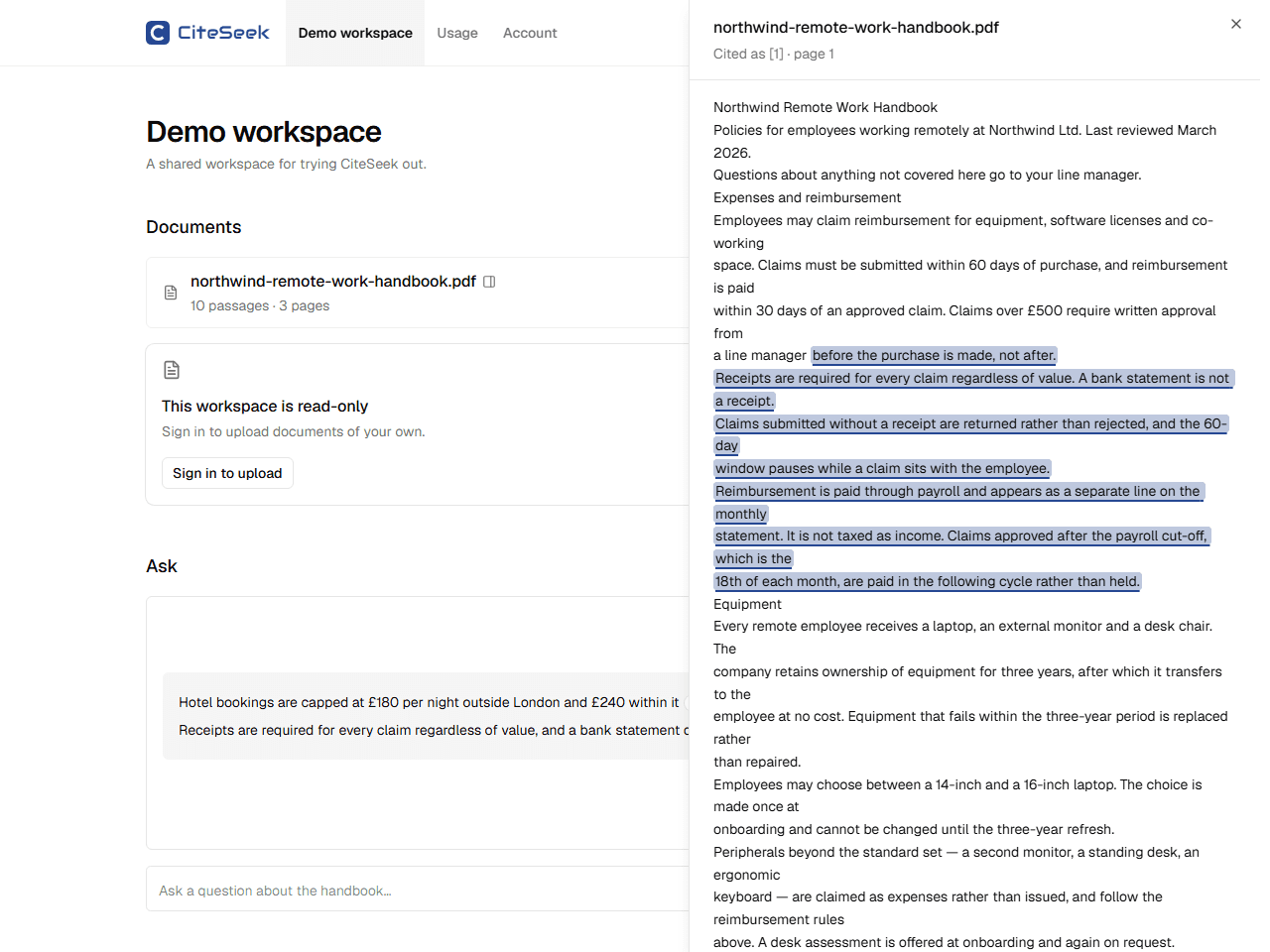
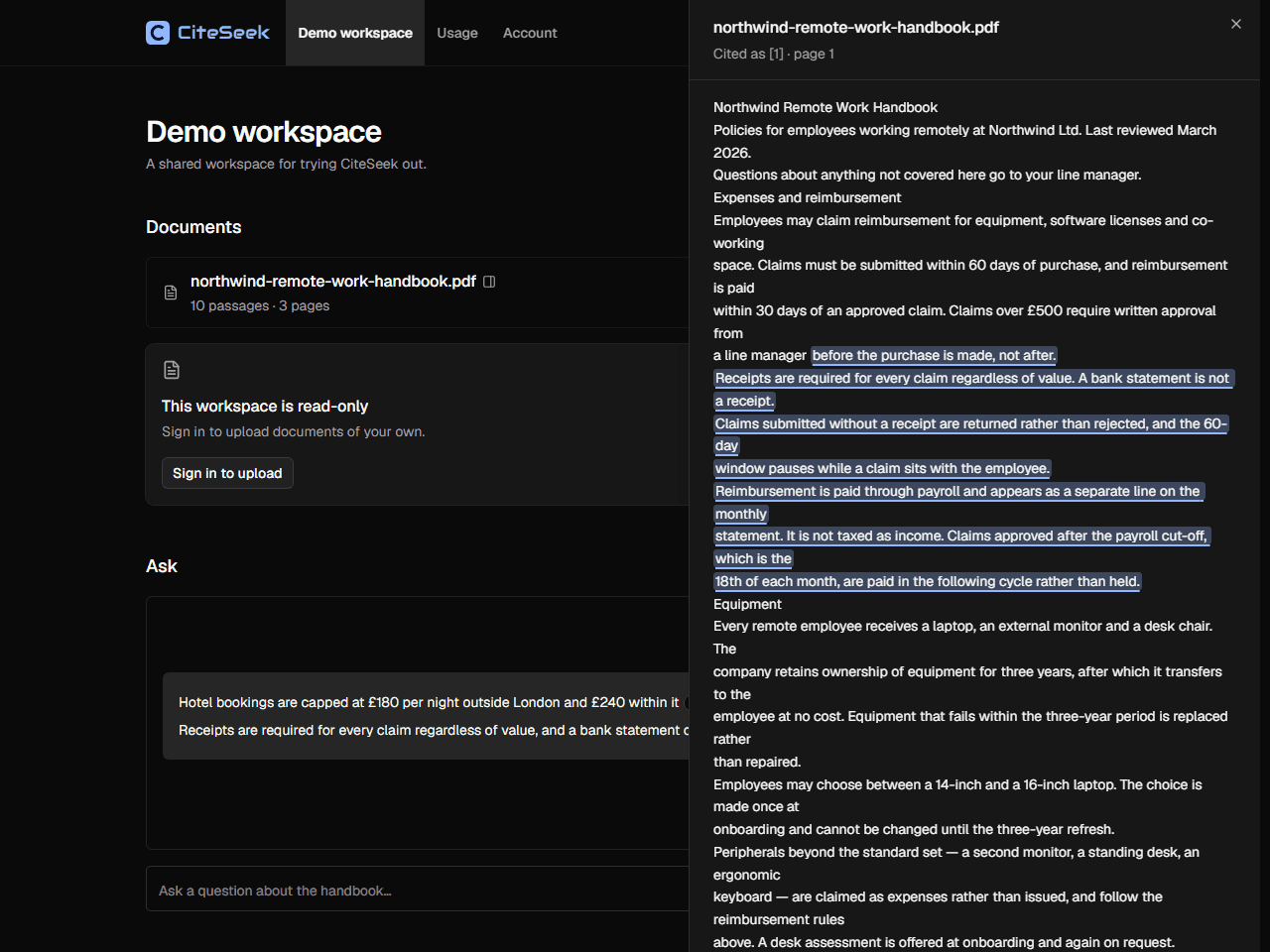
A marker opens the passage it came from
Clicking one opens the document at the exact characters the answer was grounded in, highlighted, with its page number — the offsets are recorded when the file is chunked.
What has been measured
- 365 ms
- to the first source, deployed
- 0.85 s
- to the first token of prose
- 0.95
- of answers found in the top three passages
- 89.09%
- of 1027 mutants caught in retrieval and answering
Measured rather than asserted: the method behind each number, and what it does not cover, is in the README's Numbers section.
How that guarantee is built
The passages are retrieved and sent to your browser before the model writes a word. A marker in the answer resolves against that payload, so it points at a passage that already existed — the model chooses which to cite, and cannot cite what it was not given.
A marker that resolves to nothing stays plain text rather than becoming a link, so a number the model invented cannot present itself as a source. Neither can a marker in a reply that opens in the form the model is told to use for declining: none of them becomes a link, and the reply says why, even when it then answers correctly, as can happen mid-conversation.
And when nothing retrieved is relevant enough, no answer is generated at all: the reply saying so is written by CiteSeek, not by the model.
Or keep the documents in your browser
Local mode runs the model on your machine, so the text of a document never leaves it — the one claim here that is sovereignty rather than a region on a map. It is experimental, and the page says what it measures.
One document is already in there
A fictional company handbook, parsed into passages that kept their page numbers. Ask it something and follow a marker back to the line it came from.
Open the demo workspace